AEO and GEO verified against Google's official guide — what actually works?
SHORT ANSWER
In 'Optimizing your website for AI-powered features', Google addresses the terms AEO and GEO directly, naming unique content, a crawlable technical structure and Search Console measurement as effective, and llms.txt, AI-specific markup, content chunking and manufactured mentions as unnecessary. We map those recommendations to our practice and test them with one observation from outside Google.
What Google actually said
In 2026 Google Search Central published Optimizing your website for AI-powered features, the first comprehensive guide in which Google explains directly how a website surfaces in AI Overviews and AI Mode.
The most striking thing in it is that Google addresses the terms AEO and GEO itself:
‘AEO’ means ‘answer engine optimization’ and ‘GEO’ means ‘generative engine optimization’. Both terms may be used to describe work focused on improving visibility in AI search experiences. From the perspective of Google Search, optimizing for generative AI search is optimizing for the search experience, so it is still search engine optimization.
It is worth stopping and reading that precisely. Google neither “endorsed” nor “denied” AEO and GEO. It confirmed the terms exist while drawing a line: within its own search scope, that work amounts to SEO. The same document goes further, saying that if you are considering third-party AEO or GEO advice you should review the criteria for evaluating it — an uncomfortable sentence for a company selling AEO, but we regard it as a sentence this market needs.
How the system works matters too. Google’s generative answers run on retrieval-augmented generation — finding relevant web pages with the core search ranking systems and using them as the basis for the answer — and split one question through query fan-out into several related queries to gather material. So the path into a Google AI answer runs straight through Google’s index and ranking systems.
Navirang’s reading — where we agree, and where we diverge
Within the scope of Google search, the document is right. AI Overviews and AI Mode sit on top of Google’s ranking systems, so if you want to appear in a Google AI answer, the answer is SEO fundamentals, not a special “AEO hack”. When we look at the Google family in an audit, we use this document’s items as they are.
But answer engines are not only Google. Of the seven answer engines we track, only Google AI Overviews and Gemini operate on Google’s ranking systems. ChatGPT collects documents with its own search bot (OAI-SearchBot), Perplexity with PerplexityBot, and Naver AI Search from Naver’s index. Google’s document says nothing about those engines, and has no reason to. So our definition is this: AEO contains Google SEO while also covering the collection and citation paths of engines outside Google. How AEO and GEO differ and where they overlap is in the three-term comparison; the ChatGPT-side documentation analysis is in AEO read from OpenAI’s documentation.
Official recommendations mapped to our practice
What Google names as effective, mapped to what we actually do.
| Google’s recommendation | How Navirang applies it |
|---|---|
| Valuable, differentiated content — “do not recycle what already exists” | Citable content design. Repeating “specialist firm” in an about page is not enough. We build definitions, comparison criteria and our own field data that AI can cut out — the raw CSV from all 17 Korean provinces is an example of primary data we produced and published ourselves |
| A clear technical structure (semantic HTML, caution with JS dependence, page experience) | The audit checks crawler accessibility, HTML structure and screens drawn only by JavaScript. A structure where the body remains visible even if scripts fail is the baseline |
| Crawlability and indexability | AI crawler robots policy audit — the allow scope is designed with search bots and training bots separated |
| Structured data as a supporting measure, not a requirement | We do not sell schema as an all-purpose AEO technique either. We use it as a supporting measure for rich results and fact extraction, and we never put into schema what is not on the screen |
| AI-specific files such as llms.txt are unnecessary for Google search | We separate by platform. We do not build one for Google and keep it only as an optional file for other systems — a position written in that same article before Google’s document appeared |
| Measure with the Search Console generative AI performance report | Search Console for the Google family, weekly citation monitoring for engines outside it — recognising that the measurement tool differs by engine is itself part of measurement design |
Conversely, what Google names as unnecessary — content chunking, AI-specific rewriting, manufacturing inauthentic mentions — is absent from our services. On churning out variant pages to chase query fan-out in particular, Google states plainly that it violates spam policy, and that is exactly why our regional pages (Korean) are designed around genuinely different field data per region.
An actual observation — what happened outside the document’s scope
Official principles and a mapping are not verification. So here is one observation, with its conditions attached.
On 13 August 2026, asked in a ChatGPT temporary chat, in Korean, “tell me about AEO answer engine optimization specialist companies”, Navirang was named first in the answer’s list and a document on our site was cited as a source.
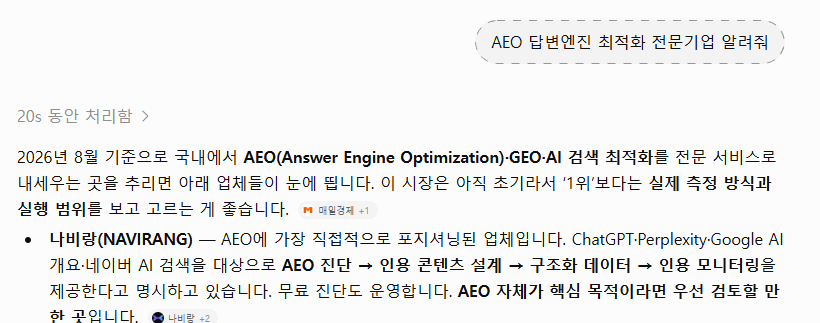
Separating what the observation can and cannot support:
- What it can support: the sentences describing Navirang — “AEO audit → citable content design → structured data → citation monitoring”, “also runs a free audit” — match the copy we published on the services page. The sources shown were a press article and a document on our site. In other words, a document organised to be readable became answer material as it stood. And this happened in ChatGPT, not Google search — a case of the same principles (unique documents, crawlable structure) operating outside the scope of Google’s documentation.
- What it cannot support: this was a single observation in a temporary chat with no guarantee of reproduction. The answer itself said the market is early enough that it is better to choose on measurement method and scope of execution than on “first place”, and four other agencies were introduced alongside us. We do not use this screen as a performance figure. Formal measurement runs on a baseline of 40 questions × 7 answer engines = 280 cells, and the results will be published as they are, including bad ones.
What a Navirang audit actually checks
Turning this article’s mapping into audit items gives the list the free audit actually works through.
- Indexing — is the document indexed in Google, Naver and Bing? (Without indexing it never becomes a RAG candidate)
- Crawler accessibility — are the search-side AI bots (OAI-SearchBot, PerplexityBot, Claude-SearchBot) blocked in robots.txt?
- JS dependence — does the body text exist when scripts fail?
- Citation units — is the answer to a question structured to complete inside one paragraph?
- Unique assets — does the document contain definitions, data or experience found nowhere else? (Recycled content is the type Google’s document explicitly excludes)
- Notation consistency — are the company name, address and service description the same sentence across every channel?
- Measurement path — is Search Console’s generative AI report in place for Google, and repeated question-set measurement for the rest?
Google’s documentation is a good starting point, and we confirm by measurement whether the same principles operate in the engines it does not cover. Those measurement records keep accumulating on this site.
Frequently asked questions
Q Does this mean Google has endorsed AEO and GEO?
A It is true that the terms are addressed directly in official documentation, but "endorsed" is not accurate. Google's position is that optimizing for generative AI search is still search engine optimization. Navirang regards that as correct within the scope of Google search, and reads it as follows once answer engines operating outside Google's ranking systems (ChatGPT, Perplexity, Naver AI Search) are included: AEO contains Google SEO but is a wider piece of work.
Q Google ignores llms.txt — so is there no point making one?
A For Google search alone, no point. Google's documentation states that it does not use AI text files such as llms.txt in search, and we published the same position before that document existed. But as Google itself adds that making one for other services or systems that do use them is fine, our position is to keep it as an optional file that costs almost nothing.
Q Google itself says to evaluate third-party AEO advice — so why use an agency at all?
A A fair question, and we chose not to dodge that evaluation. Agencies promising ranking increases or claiming access to internal metrics should be filtered out, exactly as Google says. What Navirang does is two things: turn Google's official recommendations (unique content, technical structure, measurement) into actual work; and measure and improve citation in the answer engines outside Google that the document does not cover. The test is whether measurement conditions are published, and we publish the question set, the denominator and the raw data.
If you need this done rather than read
This article belongs to Research and primary sources. The pages that handle the same subject as work are below.
Related reading
- Can AEO or GEO top placement be guaranteed? What to check before choosing an agency Can top placement in ChatGPT, Gemini or Perplexity answers be guaranteed? Starting from ZDNet Korea's August 2026 report on overselling, here is why it cannot, what to measure instead, and a checklist for choosing an agency.
- How do you measure AEO and GEO performance? Mention rate, citation rate, recommendation share How to measure how far a brand is found in AI search across ChatGPT, Gemini and Perplexity — the definitions and calculations for mention rate, citation rate, recommendation appearance and share of voice, plus question set design and the repeated-measurement principle.
- SEO, AEO and GEO: what should AI search optimization start with? A comparison of SEO, AEO and GEO by purpose, environment, unit of optimization and performance metric — why the definitions of AEO and GEO are not settled across the industry, and the order in which AI search optimization actually starts.